
Let me be straight with you.
Buying a car in India in 2026 is one of the biggest financial decisions you’ll make. With petrol, diesel, CNG, and electric all competing for your money, the confusion is real. So forget the showroom salesperson and let’s talk like adults — with actual numbers.
What You’re Paying at the Pump Today
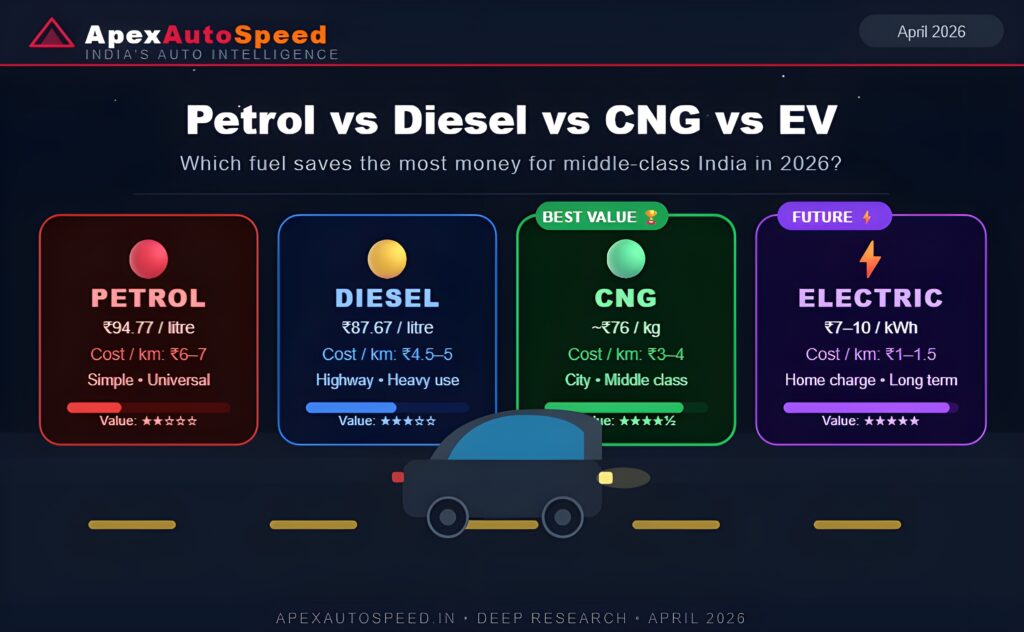
Here’s the ground reality in Delhi right now:
- Petrol: ₹94.77 per litre
- Diesel: ₹87.67 per litre
- CNG: ~₹76 per kg
- EV (home charging): ₹7–10 per kWh
- EV (public fast charger): ₹18–22 per kWh
These numbers matter because your real cost isn’t what you pay on the day you buy the car. It’s what you pay every single day you drive it.
Cost Per Kilometer – The Number That Changes Everything
| Fuel | Real Cost Per Km |
|---|---|
| Petrol | ₹6–7 |
| Diesel | ₹4.5–5 |
| CNG | ₹3–4 |
| EV (home charged) | ₹1–1.5 |
If you drive 1,500 km a month, a petrol car costs you roughly ₹9,000–10,500 in fuel. A home-charged EV? Just ₹1,500–2,250. That’s a saving of ₹7,000–8,000 every month — or ₹4–5 lakh over five years. Real money for a middle-class family.
Petrol — Simple, Safe, But Expensive to Run
Petrol is still the most popular fuel in India and there’s a reason for that. No special infrastructure, smooth performance, easy to service anywhere in the country. If you drive less than 25 km a day, live in a smaller city, or this is your first car, petrol makes complete sense. The headache is zero.
The catch? It’s the most expensive fuel to run. Every spike in crude oil prices — and India imports 85% of its crude — hits your monthly budget hard. If you’re clocking serious kilometres every day, petrol will quietly drain your wallet.
Best picks: Maruti Swift (₹6.5–9.5L), Hyundai i20 (₹7–12L), Tata Nexon Petrol (₹7.3–13L)
Diesel — The Highway King, With Conditions
Diesel used to be the automatic choice for high-mileage drivers. Better efficiency, lower fuel cost, strong torque on highways. But in 2026, the math needs checking.
Diesel variants cost ₹1–2 lakh more upfront. BS6 Phase 2 engines have higher maintenance costs — DPF filters, injectors, more complex service schedules. And if you’re in Delhi-NCR, the ongoing diesel ban debate adds real policy risk to any purchase.
The break-even calculation is important: you need to drive roughly 75,000–1,00,000 km before a diesel car pays off its price premium over petrol. That’s about five years at 20,000 km annually. Drive less than that, and diesel doesn’t add up financially.
Diesel still makes sense if you drive 50+ km daily on highways, live outside major metros, and plan to keep the car for seven-plus years.
Best picks: Kia Seltos Diesel (₹14–18L), Hyundai Creta Diesel, Toyota Fortuner (₹35L+) for those with bigger budgets
CNG — The Unsung Hero for Middle-Class India
Honestly? For the typical Indian family doing 40–80 km a day within a city, CNG is the smartest buy right now. Full stop.
Running costs of ₹3–4/km are almost half of petrol. CNG now has over 8,000 stations across 300+ districts — no longer just a Delhi-Mumbai thing. Since India imports only 46% of its CNG (versus 85% for crude), prices are far more stable and government-controlled. When petrol prices went haywire earlier this year, CNG owners barely noticed.
Factory-fitted CNG from Maruti and Tata has solved most old complaints. Newer dual-cylinder models barely eat into your boot space. Your warranty stays intact. And the savings are serious — driving 30 km/day in Delhi, CNG saves you roughly ₹24,000 per year compared to petrol. The factory CNG premium pays itself back in 12–24 months.
The honest downsides: station queues during peak hours, slightly lower engine power in CNG mode, and limited CNG availability for long highway trips.
Best picks: Tata Punch iCNG (₹6.75–10.6L), Maruti Wagon R CNG (₹6.5–7.5L), Tata Nexon iCNG (₹8.3–13L), Maruti Ertiga CNG for families (₹9–12L)
Electric (EV) — The Future Is Real, But Ask These Questions First
EVs have the lowest running cost — there’s simply no debate. At ₹1–1.5/km with home charging, you save more than any other fuel type. Virtually zero routine maintenance. Silent city driving. Government subsidies in several states. The technology is genuinely good now.
But there’s one question that decides everything: Can you charge at home?
If you have dedicated parking where you can plug in overnight, an EV is brilliant. If you depend on public fast chargers at ₹18–22/kWh, your running cost jumps to CNG levels — while also taking 30+ minutes per charge. The convenience advantage disappears entirely.
EVs also cost ₹2–4 lakh more upfront than equivalent CNG or petrol cars. You need to hold the car for at least 3–5 years to recover that premium through fuel savings. For daily city commutes with home charging and long-term ownership, EVs are the financially correct choice.
Best picks: Tata Punch EV (₹9.99–14L), Tata Nexon EV (₹14–20L), Hyundai Creta Electric (₹17L+)
So, Which One Should You Actually Buy?
Here’s the honest decision, no fluff:
- Under 25 km/day, small city, first car? → Petrol. Zero complications.
- 40–80 km/day in city, CNG pump nearby? → CNG. Best value for money in India right now.
- 40+ km/day in city AND home charging available? → EV. Long-term winner, lowest lifetime cost.
- 50+ km/day on highways, outside NCR? → Diesel or Strong Hybrid (Grand Vitara, Hyryder).
The Final Word
There is no single best fuel in 2026. There’s only the best fuel for your life — your daily distance, your city, your parking situation, and how long you’ll keep the car.
Do the math before you walk into a showroom. The cheapest car to buy is almost never the cheapest car to own.
Drive smart.